 CULTURETECHLENS
Cape Town
VERIFIED evidence grade of this record
CULTURETECHLENS · “Culture, Clearly Seen.” · Black Cultural Intelligence
Research record
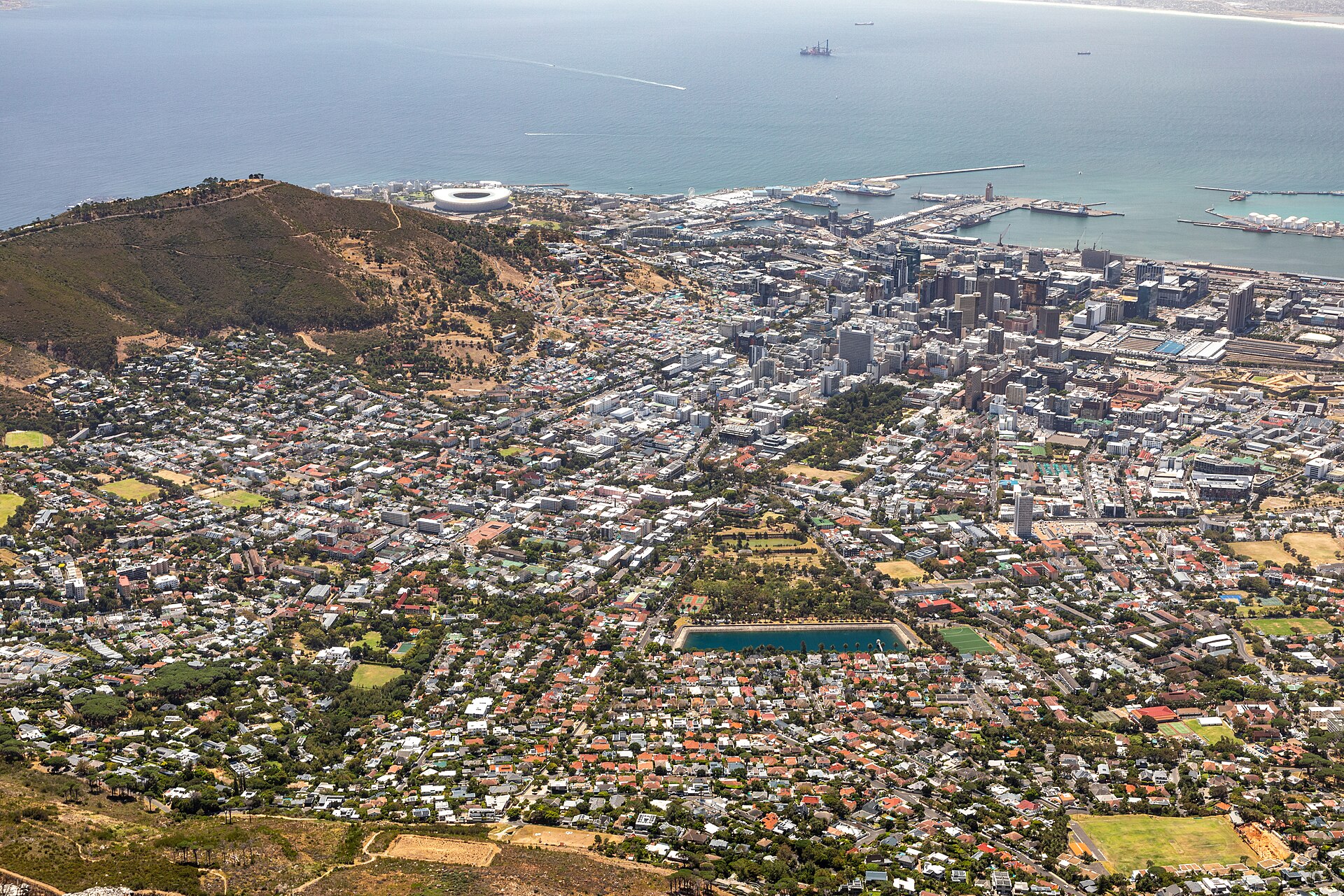
Photo: Dietmar Rabich, CC BY-SA 4.0, via Wikimedia Commons · Source: CultureTechLens
Rights basis: CC BY-SA 4.0 (https://creativecommons.org/licenses/by-sa/4.0) — attribution as recorded in Wikimedia Commons machine-readable license metadata
Cape Town is South Africa's legislative capital — the seat of its national Parliament, one of three capitals the country divides among Cape Town (legislative), Pretoria (administrative), and Bloemfontein (judicial). The classification is the fact the CTL record verifies, from the Department of International Relations and Cooperation's official South Africa in brief. Britannica gives the city its standing epithet: because it was the site of the first European settlement in South Africa, Cape Town is known as the country's "mother city." The city began in 1652, when the Dutch East India Company established a refreshment station for its ships on the shores of Table Bay, beneath Table Mountain, whose flat top rises 3,563 feet over the city bowl. The Parliament building, built for the colonial government and first occupied in 1885, became the seat of Parliament with the Union of South Africa in 1910 — capital status arrived as a compromise among the union's rival colonies, and it has never moved.
The mother city's founding is also a slavery record, and the cultural record keeps both. The Dutch East India Company imported enslaved people from East Africa, Madagascar, and the Bay of Bengal region, and Muslim captives from the East Indies carried their religion and culture into the settlement's foundations. The city's living memory of that origin is the Kaapse Klopse, the Cape Town Minstrel Carnival held each year on January 2 — Tweede Nuwe Jaar, Second New Year — the single day off that had been granted to enslaved people at the Cape. As many as thirteen thousand minstrels take to the streets in bright colors, with painted faces, umbrellas, banjos, and ghoema drums, organized into self-governing troupes whose custom has been preserved since the mid-nineteenth century; the first carnival troupe is estimated to have formed in 1887. Under apartheid the festival was called the Coon Carnival; it now stands officially as the Cape Town Minstrel Carnival, and the graph's diaspora note for this city names it first.
The built city still reads as a Dutch refreshment station that grew a parliament. On Strand Street stands the Castle of Good Hope, raised by the Company between 1666 and 1679; the old Heerengracht, the canal-street of the first settlement, was renamed Adderley Street in 1850 and still runs as the main thoroughfare from the shore to the Company's gardens, past the government buildings at the top of the avenue. Twentieth-century dredging reclaimed 480 acres along the shore as the Foreshore, pushing the docks outward and giving the modern city its extended waterfront face.
The climate writes the city's daily theater: a Mediterranean regime of wet winters and dry summers, mild at an average high of about 70 degrees Fahrenheit in high summer, and swept by the strong southerly winds Capetonians call the "Cape doctor" because they scour the air clean — the same winds that pour the famous tablecloth of cloud over Table Mountain's flat top. Britannica's population figure for the urban agglomeration stood at an estimated 3,103,000 in 2005; the municipality has grown well past that mark since, a port and provincial capital whose fruit exports, ship repair, food processing, and winemaking fill out the economic record beneath the legislative one.
The note names District Six second, and District Six is the wound the city has chosen to remember in public. An inner-city neighborhood beside the center — home, by the turn of the twentieth century, to freed slaves' descendants, artisans, merchants, Cape Malay Muslims, Black Xhosa residents, and Jewish immigrants — it was declared a whites-only area under the Group Areas Act on February 11, 1966. Removals began in 1968; by 1982 more than sixty thousand people had been relocated to townships on the Cape Flats, and the houses were bulldozed, leaving mostly places of worship standing on renamed, empty land. The District Six Museum, founded in 1994 on Buitenkant Street with a street map of the old district covering its floor and former residents' handwritten notes marking where their homes stood, became the memory's keeper; in 2004 Nelson Mandela handed keys to the first returning residents, and in December 2019 the name District Six was officially restored. The CTL graph locates the District Six Museum in this city, alongside the University of Cape Town, the Zeitz Museum of Contemporary Art Africa, and the Cape Town International Jazz Festival. CTL holds Cape Town as a VERIFIED place record: the legislative capital and mother city of South Africa, a port founded as a slaveholding refreshment station in 1652, whose January carnival and whose bulldozed neighborhood together anchor the Cape's Black and creole cultural record.
Sources for this record
- South Africa in Brief — Department of International Relations and Cooperation (DIRCO), Republic of South Africa
Claims supported: Cape Town is a city in South Africa and its legislative capital, with the national Parliament located there (official classification carried in the CTL record). - Cape Town — Encyclopaedia Britannica
Claims supported: Legislative capital of South Africa and capital of Western Cape; 'mother city' as the site of the first European settlement; origin in 1652 as a Dutch East India Company refreshment station on Table Bay; Table Mountain at 3,563 feet; three capitals (Cape Town legislative, Pretoria administrative, Bloemfontein judicial) as a 1910 union compromise; Parliament building first occupied 1885 and seat of Parliament from 1910; enslaved people imported from East Africa, Madagascar, and the Bay of Bengal area, with Muslims from the East Indies bringing their religion. - District Six — Wikipedia
Claims supported: District Six declared a whites-only area under the Group Areas Act on February 11, 1966, removals from 1968; more than 60,000 people relocated to the Cape Flats by 1982 and homes bulldozed; the District Six Museum (foundation 1989, museum 1994) and its floor map with former residents' notes; Mandela handed keys to the first returning residents on February 11, 2004; the name District Six officially restored in December 2019. - Kaapse Klopse — Wikipedia
Claims supported: The Kaapse Klopse, officially the Cape Town Minstrel Carnival, takes place annually on January 2 (Tweede Nuwe Jaar) in Cape Town; as many as 13,000 minstrels in bright colors with umbrellas and instruments, self-organized into troupes; custom preserved since the mid-19th century, first troupe estimated 1887; rooted in the single day off granted to enslaved people on January 2; formerly called the Coon Carnival under apartheid and officially renamed.
Citations
"Cape Town." Encyclopaedia Britannica. Accessed October 25, 2026. https://www.britannica.com/place/Cape-Town.
"District Six." Wikipedia. Accessed October 25, 2026. https://en.wikipedia.org/wiki/District_Six.
"Kaapse Klopse." Wikipedia. Accessed October 25, 2026. https://en.wikipedia.org/wiki/Kaapse_Klopse.
Published October 25, 2026, from the head-verified staged record in the Entity Depth Program (Batches 001–003). Source: CultureTechLens
More place records
Browse the full directory: all entity records
Record CTL-E-5487 · CultureTechLens Knowledge Graph · evidence grade: VERIFIED · 4 sources · first published October 25, 2026, from the head-verified Entity Depth staged record CTL-PL-0061 (canonical master ID — canonical merge pending the founder’s classification sitting).
Directory: all entity records · the knowledge graph
Cite this record
Chicago: CultureTechLens. “Cape Town (CTL-E-5487).” CultureTechLens Knowledge Graph. Chicago, IL: CultureTechLens, 2026. https://culturetechlens.com/graph/entities/ctl-e-5487/
APA: CultureTechLens. (2026). Cape Town (CTL-E-5487) [Entity record]. CultureTechLens Knowledge Graph. https://culturetechlens.com/graph/entities/ctl-e-5487/
MLA: CultureTechLens. “Cape Town (CTL-E-5487).” CultureTechLens Knowledge Graph, 2026, https://culturetechlens.com/graph/entities/ctl-e-5487/
Citation guidance for teachers, journalists, and funders: How to Cite Us.
From the Archive
The archive in pictures
The people, places, and institutions this work documents. Photographs from the CultureTechLens research record — rights-cleared, credited, and cited like everything else here.
Trust & evidence
Evidence before authority. CultureTechLens publishes its methods, its limits, and its corrections alongside its findings. Claims carry grades — VERIFIED, SUPPORTED, PROVISIONAL, DISPUTED, UNRESOLVED — and unknowns are never reported as zero.
Every claim graded. Every source named. Every correction public — see the corrections log.