 CULTURETECHLENS
Johannesburg
VERIFIED evidence grade of this record
CULTURETECHLENS · “Culture, Clearly Seen.” · Black Cultural Intelligence
Research record
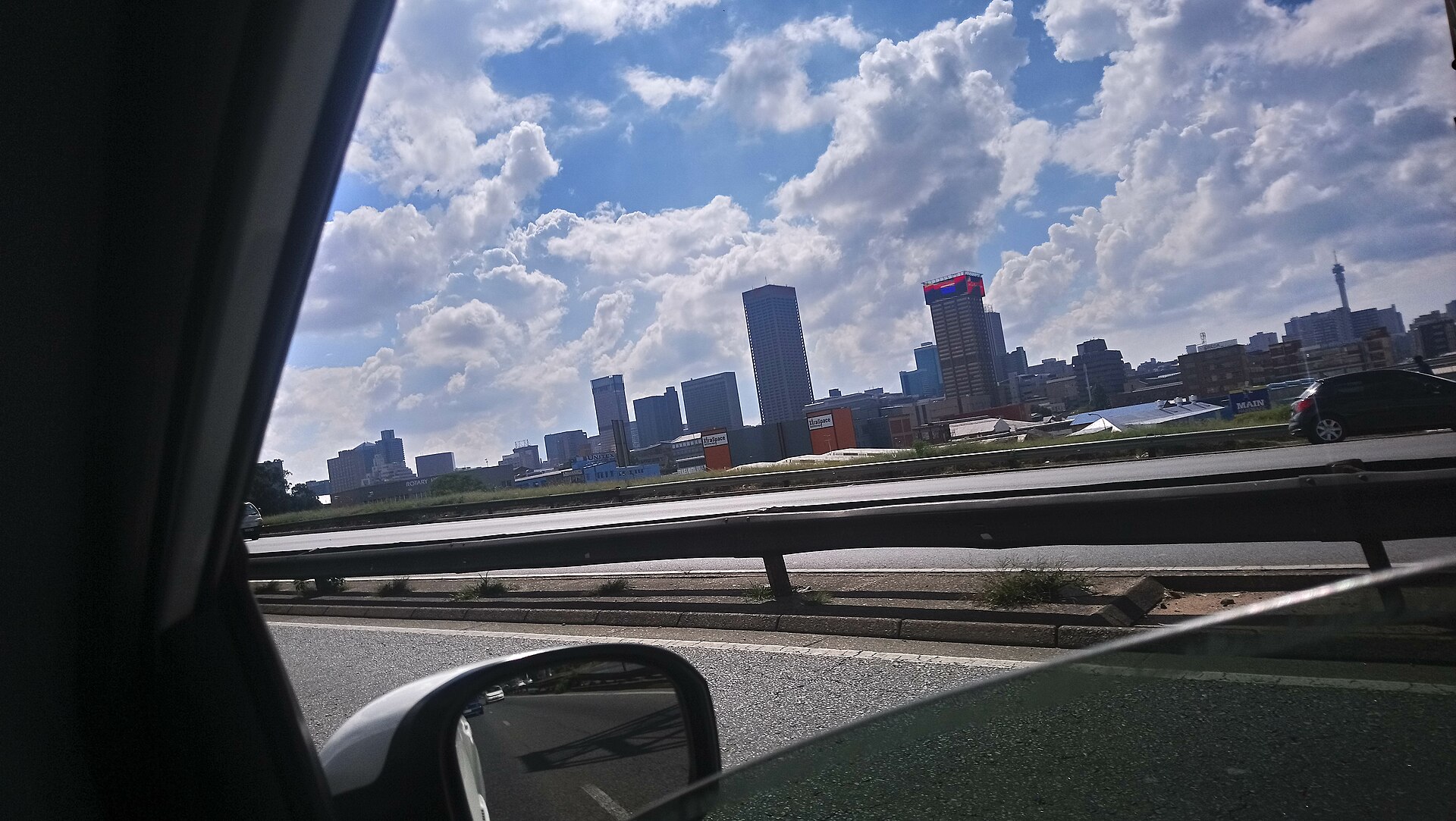
Photo: Khaanya96, CC BY-SA 4.0, via Wikimedia Commons · Source: CultureTechLens
Rights basis: CC BY-SA 4.0 (https://creativecommons.org/licenses/by-sa/4.0) — attribution as recorded in Wikimedia Commons machine-readable license metadata
Johannesburg exists because of what lay under it. The city was founded in 1886 following the discovery of gold on the Witwatersrand — the Rand — the ridge of gold-bearing rock that arcs beneath South Africa's Highveld, and Gauteng, the province it anchors, takes its name from a Sotho word meaning "Place of Gold." Britannica describes Johannesburg as the country's chief industrial and financial metropolis and one of the youngest of the world's major cities. In its day the Witwatersrand gold industry accounted for more than forty percent of the world's annual gold production, and the landscape still carries the industry's remnants: rusting headgear and towering yellow-white mine dumps around a city whose mines mostly closed in the 1970s. South Africa's official guide, the source carried in the CTL record, classifies the city formally as one of the country's eight metropolitan municipalities. Its municipal population was recorded at 4,803,262 in 2022.
The city's geography is an apartheid document. Britannica's account is plain: Johannesburg's layout reflects nearly a century of racially driven social engineering that climaxed under apartheid, the system of racial segregation in force from 1948 to 1994. Under the Group Areas Act of 1950, each of the more than five hundred suburbs and townships of Greater Johannesburg was reserved for a single race group; the act was repealed in 1991, but the pattern it built persists. The majority of Black residents still live in townships on the urban periphery — dormitory cities for people who worked in town — among them Alexandra, an enclave of nearly half a million people carved out of the white northern suburbs, and Soweto, the sprawling complex of the South-West Townships ten miles southwest of the center, at least three times Alexandra's size. Britannica's summary of the result is a city of extraordinary contrasts, of glass and steel skyscrapers and shantytowns, of internationally recognized universities and widespread illiteracy, of glittering abundance and desperate poverty.
The physical city is a high one. Johannesburg bestrides the Witwatersrand on the broad grassy plateau of the Highveld, at elevations between 5,700 and 5,930 feet, in a temperate climate of warm summers, mild winters, and rain that falls almost entirely in the summer months, often in late-afternoon electrical storms. The central city's rectangular street grid survives unchanged from the first survey of 1886, its narrow streets shadowed by high-rise blocks, and the metropolitan economy still runs through the headquarters of major mining houses and the Johannesburg Stock Exchange — the financial machinery of the gold economy, professionalized and moved indoors.
The post-apartheid city is still negotiating the map apartheid drew. Black Africans constitute about three-quarters of the population; manufacturing's growth in the 1930s and 1940s had already driven Black urbanization long before the law admitted it, and after 1994 the political transformation ran ahead of the spatial one, with crime pushing businesses from the old center toward safer suburbs even as the townships remained the city's population centers. That tension — a financial capital whose wealth and whose people are still sorted by a repealed statute's geography — is precisely what makes Johannesburg a diaspora record rather than a skyline: Soweto and Alexandra are not suburbs of the story. They are the story's engine room.
For a cultural-intelligence graph, Johannesburg's weight is institutional as much as demographic. Britannica points visitors to the Johannesburg Art Gallery and to the Market Theatre, the world-renowned multi-theatre complex housed in the city's old produce market, and to the Apartheid Museum for, in its words, a less sanitized version of the city's past. The CTL graph locates within Johannesburg the Apartheid Museum itself, the African National Congress, and three of South Africa's defining newspapers — the Mail & Guardian, the Sowetan, and City Press — along with the amapiano act Major League DJz. That is the post-apartheid cultural center the record's diaspora note names, in its local shorthand "Joburg": the city where South Africa's liberation movement is headquartered, where its press argues with itself in print, and where its townships keep generating the sounds the world ends up dancing to. CTL holds Johannesburg as a VERIFIED place record — a South African metropolitan municipality in Gauteng, founded on gold in 1886, shaped by apartheid engineering, and standing as a primary node of the African diaspora's urban record.
Sources for this record
- The Official Guide to South Africa 2019/20 — Government Communication and Information System (GCIS), Republic of South Africa
Claims supported: Johannesburg is a city in South Africa and one of the country's eight metropolitan municipalities (formal government classification carried in the CTL record). - Johannesburg — Encyclopaedia Britannica
Claims supported: Chief industrial and financial metropolis of South Africa; founded in 1886 following the discovery of gold; Gauteng means 'Place of Gold'; Witwatersrand industry once accounted for more than 40 percent of world annual gold production, with most city mines closed by the 1970s; apartheid-era geography under the 1950 Group Areas Act, repealed 1991; Soweto and Alexandra township populations and layout; 2022 municipal population 4,803,262; Johannesburg Art Gallery, Market Theatre, and Apartheid Museum as cultural sites.
Citations
"Johannesburg." Encyclopaedia Britannica. Accessed October 25, 2026. https://www.britannica.com/place/Johannesburg-South-Africa.
Published October 25, 2026, from the head-verified staged record in the Entity Depth Program (Batches 001–003). Source: CultureTechLens
More place records
Browse the full directory: all entity records
Record CTL-E-5496 · CultureTechLens Knowledge Graph · evidence grade: VERIFIED · 2 sources · first published October 25, 2026, from the head-verified Entity Depth staged record CTL-PL-0051 (canonical master ID — canonical merge pending the founder’s classification sitting).
Directory: all entity records · the knowledge graph
Cite this record
Chicago: CultureTechLens. “Johannesburg (CTL-E-5496).” CultureTechLens Knowledge Graph. Chicago, IL: CultureTechLens, 2026. https://culturetechlens.com/graph/entities/ctl-e-5496/
APA: CultureTechLens. (2026). Johannesburg (CTL-E-5496) [Entity record]. CultureTechLens Knowledge Graph. https://culturetechlens.com/graph/entities/ctl-e-5496/
MLA: CultureTechLens. “Johannesburg (CTL-E-5496).” CultureTechLens Knowledge Graph, 2026, https://culturetechlens.com/graph/entities/ctl-e-5496/
Citation guidance for teachers, journalists, and funders: How to Cite Us.
From the Archive
The archive in pictures
The people, places, and institutions this work documents. Photographs from the CultureTechLens research record — rights-cleared, credited, and cited like everything else here.



Trust & evidence
Evidence before authority. CultureTechLens publishes its methods, its limits, and its corrections alongside its findings. Claims carry grades — VERIFIED, SUPPORTED, PROVISIONAL, DISPUTED, UNRESOLVED — and unknowns are never reported as zero.
Every claim graded. Every source named. Every correction public — see the corrections log.