 CULTURETECHLENS
Aon Center
VERIFIED evidence grade of this record
CULTURETECHLENS · “Culture, Clearly Seen.” · Black Cultural Intelligence
Research record
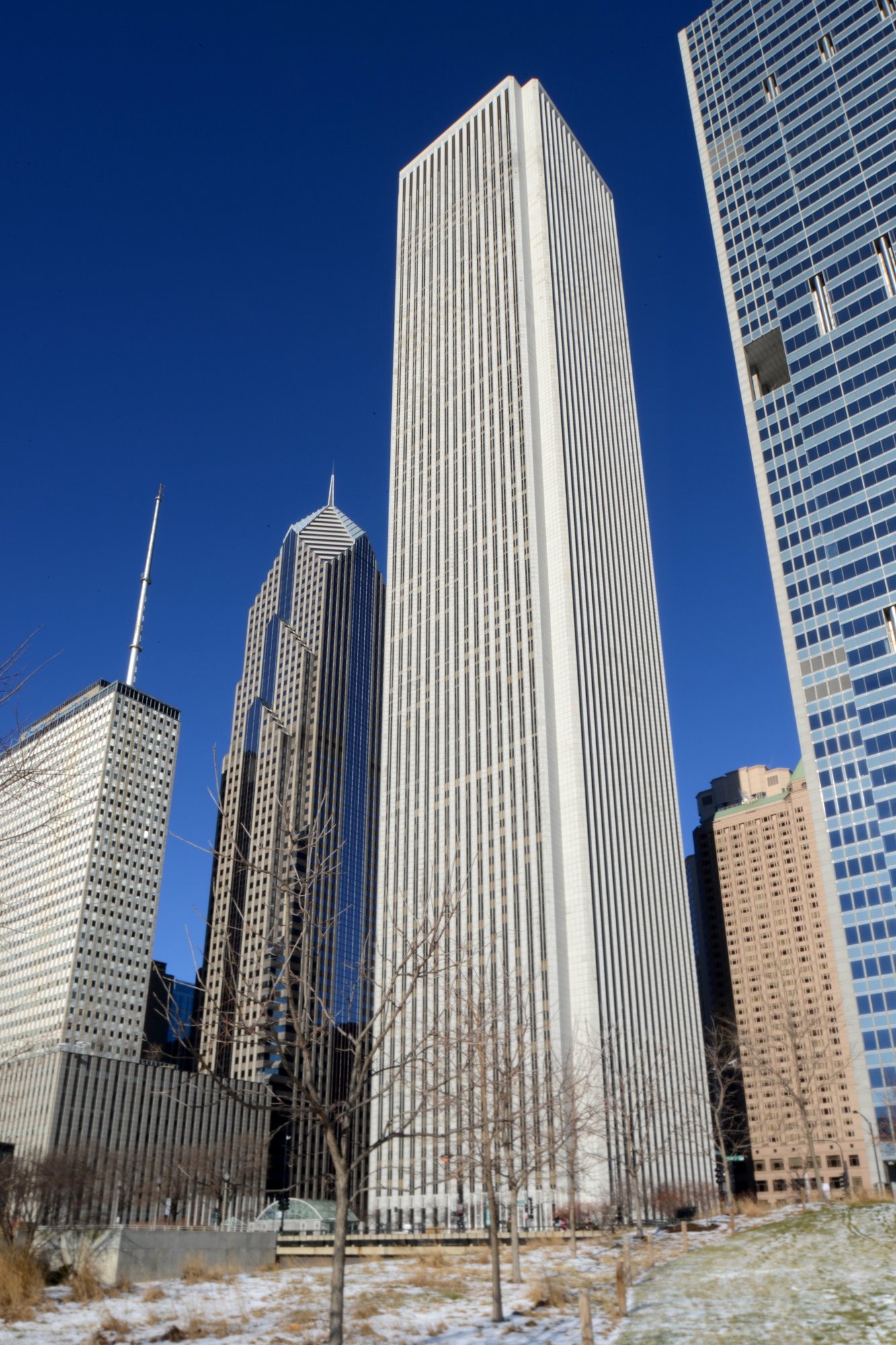
Photograph by J. Crocker, used with attribution per the copyright holder's permission statement on the file page, via Wikimedia Commons. Source: CultureTechLens
Rights basis: Attribution-only permission granted by the copyright holder (any purpose, with attribution), stated on the Wikimedia Commons file page
Stand at 200 East Randolph Street and look up: the Aon Center is the white, vertically ribbed slab at the northeast corner of Chicago's Loop, recorded by The Cultural Landscape Foundation — the master verification source for this record — as an 83-story skyscraper of 1,136 feet, designed by Edward Durell Stone with Perkins & Will, formerly the Standard Oil Building. CultureTechLens's graph places it in Chicago and on the city's tallest-buildings list for 1973–1974, the brief window when it was the tallest building in the city. Two dating cautions belong in the record's first paragraph, because the sources disagree in plain sight: the graph's own properties give the building's tallest years as 1973–1974; TCLF says it opened in 1974; reference listings variously give completion in 1973 and 1974. This archive carries the variance rather than picking a winner the sources don't support.
The building went up for the Standard Oil Company of Indiana, at a reported cost of $120 million, with construction begun in 1970. Chicagoans nicknamed it “Big Stan.” Its structure is a tubular steel frame braced by distinctive V-shaped perimeter columns, rising 83 floors above ground with five more below, 1,136 feet to the architectural top and 1,189 feet to the tip. On completion it was briefly Chicago's tallest and among the tallest in the world; the Sears Tower — now Willis Tower — surpassed it within about a year, closing the 1973–74 window the graph records. Its current standing is equally date-sensitive: present references rank it fourth-tallest in Chicago, behind the Willis Tower, Trump International Hotel & Tower, and the St. Regis Chicago, while older sources say third; rankings change as towers open, and this record dates its ranking to its sources.
The Aon Center's second life is a cladding story famous in architecture. Stone's design sheathed the tower in Carrara marble — thin panels that, under Chicago's thermal cycling, cracked and bowed outward. The entire facade was eventually stripped and re-clad in granite in the early 1990s, one of the most expensive recladding operations of its era, leaving the building the pale stone color it wears today. Naming followed corporate drift: the Standard Oil Building became the Amoco Building when Standard Oil rebranded as Amoco in 1985, and after a 1998 sale it took the name of its anchor tenant, Aon, whose United States operations it houses alongside JLL (the building's manager), a Kraft Heinz co-headquarters, and the Blue Cross Blue Shield Association. It remains what it was on opening day — a corporate monument of the oil era standing in the Loop, which is precisely why a cultural archive of Chicago keeps it: the skyline is a document too, and this slab is one of its most legible pages.
The graph's framing of the building is chronological, and the chronology is the exhibit: it appears on the Chicago's Tallest Buildings list for 1973–1974 only, the two calendar years in which the Standard Oil Building stood at the top of the city's skyline before the Sears Tower closed the question. Corporate Chicago built it as a headquarters monument — Standard Oil of Indiana's home tower, designed by Edward Durell Stone, whose taste for formal, stripped classicism gave the Loop a slab unlike the glass boxes around it. The marble failure then made it an engineering parable taught in architecture schools: thin stone, thermal movement, and a facade that had to come off panel by panel and go back up in granite. Nothing in that history is Black history in the direct sense, and the record does not pretend otherwise; the Aon Center belongs to this archive as skyline evidence — one of the fixed vertical facts of the city whose Black neighborhoods fill the surrounding records, photographed here on a January day in 2020, white granite against a winter sky, in the image attached to this record.
Sources for this record
- Aon Center — The Cultural Landscape Foundation
Claims supported: Master verification source: 83-story Chicago Loop skyscraper, 1,136 feet, designed by Edward Durell Stone and Perkins & Will, formerly the Standard Oil Building, opened 1974 per this source. - Aon Center (Chicago) — Wikipedia
Claims supported: Address 200 East Randolph Street; construction begun 1970; completion given as 1973 in the reference infobox (variance with TCLF's 1974 opening, flagged in this record); $120 million cost; 83 floors above ground and five below; 1,136 feet architectural height, 1,189 feet to the tip; 'Big Stan' nickname; briefly Chicago's tallest and fourth-tallest in the world, surpassed by the Sears Tower; tubular steel frame with V-shaped perimeter columns; Carrara marble cladding failure and granite re-cladding in the early 1990s; Amoco Building renaming (1985), 1998 sale and Aon Center naming; tenants including Aon, JLL, Kraft Heinz, and the Blue Cross Blue Shield Association; current fourth-tallest ranking in Chicago. - Aon Center — Structurae
Claims supported: Structural record corroborating the 1974 completion dating used by European engineering references (second side of the 1973/1974 variance).
Citations
Wikipedia. “Aon Center (Chicago).” Accessed October 25, 2026. https://en.wikipedia.org/wiki/Aon_Center_(Chicago).
Structurae. “Aon Center.” Accessed October 25, 2026. https://structurae.net/en/structures/aon-center-1973-chicago.
Published October 25, 2026, from the head-verified staged record in the Entity Depth Program (Batches 004–008). Source: CultureTechLens
More place records
- Bamako
- Chicago Board of Trade Building I
- Chicago Board of Trade Building II
- Holy Name Cathedral
- Morgan Park
- Sip & Sonder
Browse the full directory: all entity records
Record CTL-E-5534 · CultureTechLens Knowledge Graph · evidence grade: VERIFIED · 3 sources · first published October 25, 2026, from the head-verified Entity Depth staged record CTL-PL-0194 (canonical master ID — canonical merge pending the founder’s classification sitting).
Directory: all entity records · the knowledge graph
Cite this record
Chicago: CultureTechLens. “Aon Center (CTL-E-5534).” CultureTechLens Knowledge Graph. Chicago, IL: CultureTechLens, 2026. https://culturetechlens.com/graph/entities/ctl-e-5534/
APA: CultureTechLens. (2026). Aon Center (CTL-E-5534) [Entity record]. CultureTechLens Knowledge Graph. https://culturetechlens.com/graph/entities/ctl-e-5534/
MLA: CultureTechLens. “Aon Center (CTL-E-5534).” CultureTechLens Knowledge Graph, 2026, https://culturetechlens.com/graph/entities/ctl-e-5534/
Citation guidance for teachers, journalists, and funders: How to Cite Us.
From the Archive
The archive in pictures
The people, places, and institutions this work documents. Photographs from the CultureTechLens research record — rights-cleared, credited, and cited like everything else here.

Trust & evidence
Evidence before authority. CultureTechLens publishes its methods, its limits, and its corrections alongside its findings. Claims carry grades — VERIFIED, SUPPORTED, PROVISIONAL, DISPUTED, UNRESOLVED — and unknowns are never reported as zero.
Every claim graded. Every source named. Every correction public — see the corrections log.