 CULTURETECHLENS
Their Eyes Were Watching God
VERIFIED evidence grade of this record
CULTURETECHLENS · “Culture, Clearly Seen.” · Black Cultural Intelligence
Research record
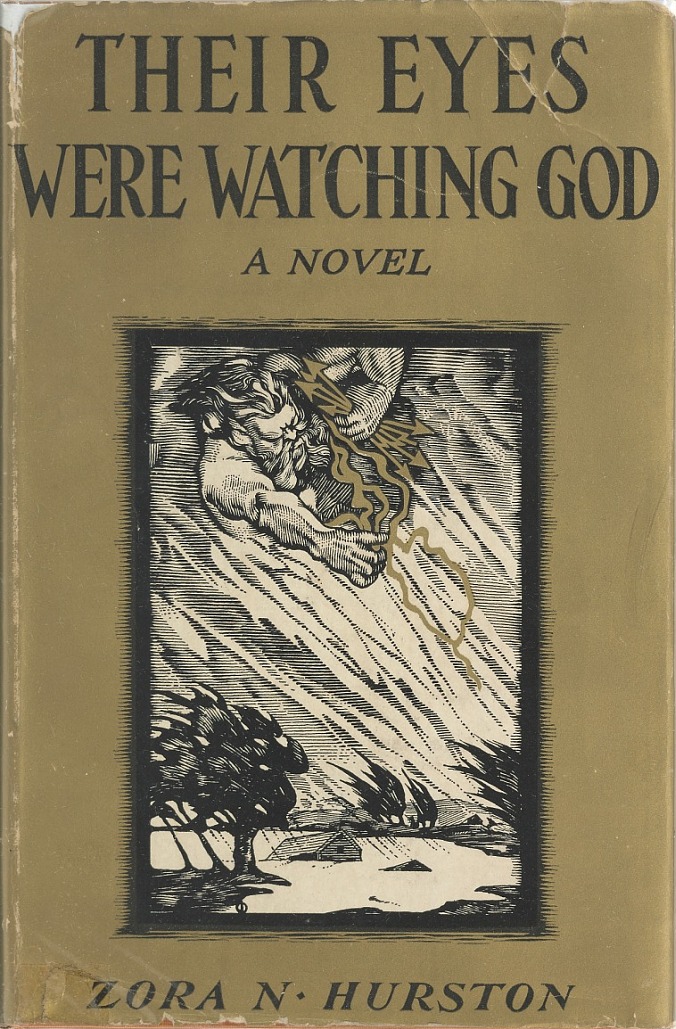
First-edition cover, J.B. Lippincott Company, public domain, via Wikimedia Commons. Source: CultureTechLens
Rights basis: public domain
Their Eyes Were Watching God, Zora Neale Hurston's 1937 novel, is now routinely shelved among the central American books of its century — HarperCollins includes it in its American Classics Collection, announced for May 5, 2026, in the press release that verifies this graph entry — but for nearly thirty years it was out of print, and its author died in a Florida welfare home in 1960 with her work largely forgotten. The distance between those two states is the novel's second story.
The novel itself is framed as testimony. Janie Crawford, returned to Eatonville, Florida, after burying her third husband, tells her life to her friend Phoeby, who may pass it on: the town may judge her, but Janie will be understood on her own terms. Raised by her grandmother, a formerly enslaved woman who prized security above all, Janie is married off as a teenager to an older farmer. She leaves him for Joe Starks, an ambitious talker who builds Eatonville — in Hurston's telling, the first incorporated Black town in the United States — and makes himself its mayor and storekeeper, silencing his wife in public for twenty years until his death frees her. Her third marriage, to the much younger drifter Tea Cake, takes her to the muck of the Everglades bean fields, into the great hurricane of 1928, and to a killing she must answer for in court. The book's images — the pear tree of Janie's girlhood vision, the horizon she spends her life traveling toward — carry its argument: a Black woman's selfhood is a story she has the right to narrate.
The 1937 reception was divided. Mainstream notices were often favorable, but leading Black critics — Richard Wright most famously — attacked the novel's dialect and folklore as pandering to white expectations and its refusal of protest as a failure of seriousness. The book sold fewer than five thousand copies and went out of print by the late 1960s. Its recovery was a deliberate act of scholarship and advocacy: Alice Walker's 1975 essay for Ms. magazine, written after she had traveled to Florida to find and mark Hurston's unmarked grave, announced the search for Zora; Robert E. Hemenway's literary biography followed in 1977; and in 1978 the University of Illinois Press reissued the novel, holding the rights for ten years and selling some 350,000 copies as course adoption spread. Harper, which had acquired the original publisher Lippincott, then reclaimed the rights; the book is published today under Harper's Amistad imprint.
The recovery's institutional milestones are worth fixing precisely. The novel was reprinted by Negro Universities Press in 1969, before the revival had a name; the University of Illinois Press edition of 1978 — the reissue that put it into classrooms — was followed in 1990 by the Harper & Row edition edited by Henry Louis Gates, Jr., with a foreword by Mary Helen Washington, the form in which a generation of students met it. In 1995 Hurston's novels and stories entered the Library of America, the closest thing American publishing has to a canon with a binding. Each step was taken by identifiable people — Walker, Hemenway, Gates, Washington — which is why the novel's history is so often taught alongside the novel itself: Their Eyes Were Watching God is not only a recovered text but the demonstration case for how recovery happens, and for how contingent a masterpiece's survival can be.
The popular seal came in 2005, when Oprah Winfrey's Harpo Productions made the novel into a television film for ABC, with Halle Berry as Janie, directed by Darnell Martin — a production praised for carrying Hurston to a mass audience and criticized by some scholars for sanding down the novel's language and its treatments of class and color. In the CultureTechLens graph the novel is a Work at VERIFIED grade, wired by an authored-by edge to Zora Neale Hurston.
Sources for this record
- HarperCollins to Publish American Classics Collection on May 5, 2026 — HarperCollins Publishers
Claims supported: Master verification source: HarperCollins lists Their Eyes Were Watching God by Zora Neale Hurston, with year 1937, in its American Classics Collection. - Their Eyes Were Watching God — BookBrowse
Claims supported: The novel sold fewer than 5,000 copies between publication in 1937 and the 1960s, when it went out of print; rediscovered in the 1970s in part through Alice Walker's Ms. magazine article on Hurston's legacy, as African American Studies programs spread; University of Illinois Press published Hemenway's Hurston biography in 1977 and took the novel's rights from J. B. Lippincott for ten years, its edition rising year by year to 350,000 copies; Harper and Row, which acquired Lippincott in 1978, reclaimed the rights, and the book is now published under Harper's Amistad imprint; further popularized by the 2005 television film starring Halle Berry as Janie, produced by Oprah Winfrey's Harpo Productions. - Scribbling Women: Zora Neale Hurston, Lost and Found — Johns Hopkins University Library
Claims supported: The edition history of the Hurston revival: the novel reprinted by Negro Universities Press in 1969 and by the University of Illinois Press in 1978, then in the Harper & Row edition of 1990 edited by Henry Louis Gates, Jr.; Hurston published by J. B. Lippincott in 1937. - Zora Neale Hurston's Their Eyes Were Watching God (1937) — Shanna Benjamin — Buzzsprout (scholarly podcast episode)
Claims supported: Published to mixed reviews in 1937; by 1977 Black women scholars who had integrated predominantly white universities were leading the reappraisal of Hurston; the novel became readily accessible after the University of Illinois Press publication of 1978 and was regularly taught through the 1980s and 1990s; the 2005 ABC television production by Oprah Winfrey starred Halle Berry as Janie Crawford, Ruben Santiago-Hudson as Joe Starks, and Michael Ealy as Tea Cake, and drew scholarly criticism for softening the novel's treatments of class, colorism, and Black vernacular.
Citations
BookBrowse. “Their Eyes Were Watching God.” Accessed October 25, 2026. https://www.bookbrowse.com/mag/btb/index.cfm/book_number/5047/their-eyes-were-watching-god.
Johns Hopkins University Library. “Scribbling Women: Zora Neale Hurston, Lost and Found.” Accessed October 25, 2026. https://www.library.jhu.edu/news/2020/09/scribbling-women-zora-neale-hurston-lost-and-found/.
Benjamin, Shanna. “Zora Neale Hurston's Their Eyes Were Watching God (1937).” Podcast episode. Accessed October 25, 2026. https://www.buzzsprout.com/2011416/episodes/10878326-zora-neale-hurston-s-their-eyes-were-watching-god-1937-episode-by-shanna-benjamin.
Published October 25, 2026, from the head-verified staged record in the Entity Depth Program (Batches 001–003). Source: CultureTechLens
More work records
Browse the full directory: all entity records
Record CTL-E-5511 · CultureTechLens Knowledge Graph · evidence grade: VERIFIED · 4 sources · first published October 25, 2026, from the head-verified Entity Depth staged record CTL-W-0072 (canonical master ID — canonical merge pending the founder’s classification sitting).
Directory: all entity records · the knowledge graph
Cite this record
Chicago: CultureTechLens. “Their Eyes Were Watching God (CTL-E-5511).” CultureTechLens Knowledge Graph. Chicago, IL: CultureTechLens, 2026. https://culturetechlens.com/graph/entities/ctl-e-5511/
APA: CultureTechLens. (2026). Their Eyes Were Watching God (CTL-E-5511) [Entity record]. CultureTechLens Knowledge Graph. https://culturetechlens.com/graph/entities/ctl-e-5511/
MLA: CultureTechLens. “Their Eyes Were Watching God (CTL-E-5511).” CultureTechLens Knowledge Graph, 2026, https://culturetechlens.com/graph/entities/ctl-e-5511/
Citation guidance for teachers, journalists, and funders: How to Cite Us.
From the Archive
The archive in pictures
The people, places, and institutions this work documents. Photographs from the CultureTechLens research record — rights-cleared, credited, and cited like everything else here.



Trust & evidence
Evidence before authority. CultureTechLens publishes its methods, its limits, and its corrections alongside its findings. Claims carry grades — VERIFIED, SUPPORTED, PROVISIONAL, DISPUTED, UNRESOLVED — and unknowns are never reported as zero.
Every claim graded. Every source named. Every correction public — see the corrections log.